1 / 1

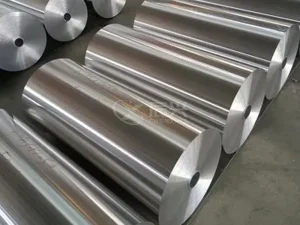
Battery aluminum foil differs from conventional aluminum foils due to its strict performance requirements tailored to battery operating conditions. Its key characteristics are as follows:
Ultra-high Purity: The aluminum content typically exceeds 99.9% (3N) and can reach up to 99.99% (4N) for high-end power batteries. High purity minimizes impurity elements (such as Fe, Si, Cu) that could cause side reactions in the battery, ensuring electrochemical stability.
Ultra-thin Thickness with Uniformity: Common thickness ranges from 4μm to 20μm, with 6μm, 8μm, and 12μm being the most widely used specifications. The thickness deviation is controlled within ±0.3μm to ensure uniform current distribution and avoid local overheating.
Excellent Conductivity: The electrical conductivity is ≥35 MS/m, which reduces the internal resistance of the battery and improves charge-discharge efficiency. High conductivity is particularly crucial for high-rate discharge scenarios like NEVs.
Superior Mechanical Properties: It has high tensile strength (≥150 MPa for 8μm foil) and good elongation (≥3%), enabling it to withstand the stress of electrode coating, rolling, and battery cycling without cracking or breaking.
Flat Surface & Strong Adhesion: The surface roughness (Ra) is controlled between 0.1μm and 0.5μm, ensuring strong adhesion with positive electrode active materials (e.g., lithium cobalt oxide, lithium iron phosphate) and preventing active material shedding during cycling.
Electrochemical Stability: It remains stable in the high-potential environment of the lithium-ion battery positive electrode (3.0–4.5V vs. Li/Li⁺) without undergoing oxidation or dissolution, ensuring long battery cycle life.
The production of battery aluminum foil is a high-precision process with strict control over each step to ensure performance consistency. The main steps are as follows:
High-Purity Aluminum Ingot Casting: High-purity aluminum ingots (3N–4N) are melted and cast into aluminum coils through continuous casting and rolling, with strict control of impurity content during the casting process.
Hot Rolling: The cast aluminum coils are hot-rolled to a thickness of 2–5mm, refining the grain structure and improving mechanical properties.
Cold Rolling: This is the core step to achieve ultra-thin thickness. Through multiple passes of cold rolling (with intermediate annealing to eliminate work hardening), the aluminum coil is gradually thinned to the target thickness (4–20μm). The rolling speed, pressure, and annealing temperature are precisely controlled to ensure thickness uniformity.
Surface Treatment: A thin layer of oxide film is formed on the surface through chemical treatment or electrochemical oxidation, enhancing the adhesion with active materials and improving corrosion resistance.
Slitting & Cutting: The large-width aluminum foil is slit into rolls of specific widths (matching battery cell sizes) and cut into sheets of required lengths. Edge burrs are strictly controlled to avoid piercing the battery separator.
Quality Inspection: Key indicators such as thickness, purity, conductivity, tensile strength, surface roughness, and flatness are comprehensively inspected using precision instruments to ensure compliance with battery-grade standards.
As the core positive current collector of lithium-ion batteries, battery aluminum foil is widely used in various fields driven by the rapid development of new energy industries:
It is the main current collector for power batteries of passenger cars, commercial vehicles, and two-wheelers. For example, 8μm–12μm aluminum foil is used in ternary lithium and lithium iron phosphate power batteries, contributing to high energy density and long cycle life.
Applied in stationary energy storage (grid-connected energy storage, off-grid power supply) and portable energy storage (outdoor power stations). Its stable mechanical and electrochemical properties ensure the reliability of energy storage systems over long-term operation.
Used in batteries for smartphones, laptops, tablets, and wearable devices. Ultra-thin aluminum foil (4μm–6μm) is adopted to reduce battery thickness and increase energy density, meeting the lightweight and miniaturization needs of consumer products.
Applied in special batteries such as aerospace batteries, medical equipment batteries, and power tool batteries, where high purity and stability are required.
In lithium-ion battery positive current collectors, battery aluminum foil has irreplaceable advantages compared to alternative materials such as copper foil and stainless steel foil:
| Alternative Material | Advantages of Battery Aluminum Foil | Key Reason |
|---|---|---|
| Copper Foil | Lower cost (about 1/3 of copper foil), stable in high-potential environments, lighter weight | Copper foil is prone to oxidation at high potentials (positive electrode), while aluminum foil forms a stable oxide film for protection; aluminum has lower market price than copper. |
| Stainless Steel Foil | Better conductivity (35 MS/m vs. 15 MS/m of stainless steel), lighter weight (density 2.7g/cm³ vs. 7.9g/cm³ of stainless steel), lower internal resistance | Stainless steel has high resistivity, which increases battery internal resistance; its high density reduces battery energy density. |
| Titanium Foil | Much lower cost (about 1/10 of titanium foil), easier processing, and mature industrial chain | Titanium foil is expensive and difficult to produce in ultra-thin specifications, making it unsuitable for large-scale battery applications. |